


UM research reveals the neural basis of how history choices and current reward shape repeated moral decision-making
A research team led by Prof. Haiyan Wu from the Centre for Cognitive and Brain Sciences (CCBS) and the Department of Psychology at the University of Macau (UM) has unveiled how the human brain integrates history choices and current reward into repeated moral decisions. Using a combination of mouse-tracking and functional MRI (fMRI), the team demonstrated that repeated moral decisions is driven by self-consistency (a desire to remain consistent with one’s own previous decisions) and reward. The findings provide new neurocomputational evidence for understanding how brain process self-consistency and reward in repeated moral decisions, and have been published in the international journal Imaging Neuroscience.
In daily life, individuals are likely to confront numerous instances of repetitive or analogous decision-making contexts. While we may adapt our decision-making strategies to the same situation in different contexts, there is a tracking of consistency that permeates our repeated decisions. Choice consistency refers to repeating the previous choices, which is quantified by cumulative responses (CR) – the time of choosing the same option across all repetitions. The desire to behave consistently is a powerful determinant of human behavior in repeated situations. When it comes to morality, maintaining consistency is crucial to ensure that our decisions align with our values, beliefs, or self-image. However, the cognitive and neural mechanisms through which past choices influence current moral behavior have remained unclear.
The experiment was a self-paced information transmission task with an MRI-compatible mouse inside the MRI scanner. Participants were asked to deliver information to another person 9 times who was playing a trivia game where players answer questions across various categories. As shown in Figure. 1, the task was comprised of nine runs, and each run consisted of 20 trivial questions (e.g., When do penguins usually lay their eggs?) presented in the middle of the screen. For every trial, the question was presented in the middle of the screen, and the start button was located at the bottom at the beginning of every trial. Participants were free to press the start button when they were prepared. Once they pressed the start button, correct answer (May) and incorrect answer (July) were shown in the left and right corners of the screen. Each choice was accompanied by other information, including which was the correct answer (marked with a black asterisk), the monetary reward, and the times the option had been chosen for the same question item (marked as red triangles and only be shown in runs 2$−$9). To induce participants to choose between reward and honesty, we set more money for the incorrect answer in over 50% of the trials.
This results shows that although reaction times decreased with task repetition, but the mouse-tracking index of conflict (AUC) remained stable and was selectively associated with response entropy, indicating that individuals with more inconsistent choices experienced greater decisional conflict. Drift–diffusion modelling further revealed that both relative reward and relative cumulative responses (CR) contributed to evidence accumulation, with higher reward weights predicting greater entropy and higher dishonesty, whereas higher consistency weights predicted more stable behaviour; importantly, the reward weight mediated the relationship between AUC and entropy. At the neural level, choice conflict was encoded in the precuneus and showed distributed multivariate representations overlapping with reward anticipation, error processing, self-referential, and maintenance-related meta-analytic maps. Finally, inter-subject representational similarity analysss demonstrated that conflict-related activity patterns in IFG, ACC, TPJ, retrosubicular area, IPS encoding both CR and reward.
This study demonstrates that repeated moral decisions rely on an interplay between reward processing and self-related mechanisms that maintain internal consistency. The findings highlight how the brain incorporates past behaviour into present value computation and provide a new framework for understanding the neural basis of repeated moral behavior.
The corresponding author of the study is Prof Haiyan Wu. The first author is Xinyi Julia Xu, doctoral researcher at UM’s Centre for Cognitive and Brain Sciences. This work is mainly supported by the Science and Technology Development Fund (FDCT) of Macau [0112/2024/RIA2, 0041/2022/A], the Natural Science Foundation of Guangdong Province (2021A1515012509), and the MYRG of the University of Macau (MYRG-GRG2025-00175-ICI). We thank Prof. Xiaolin Zhou and Prof. Kang Lee for their helpful comments on the manuscript.
The full research article is available at: https://doi.org/10.1162/IMAG.a.1047
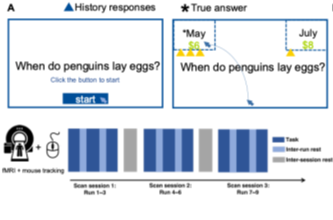
Experimental design
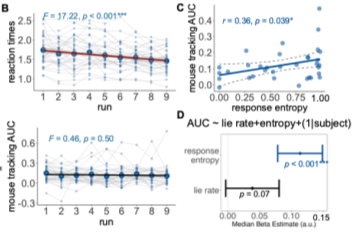
Behavioral results
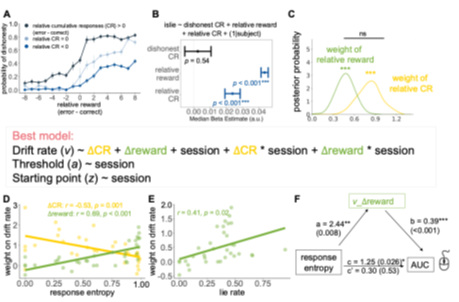
Results of behavioral modeling
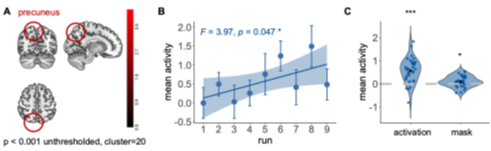
Precuneus encodes AUC
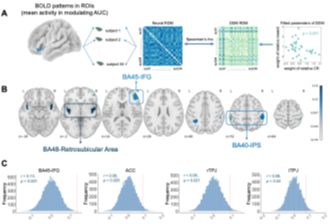
Inter-subject representational analysis(IS-RSA)
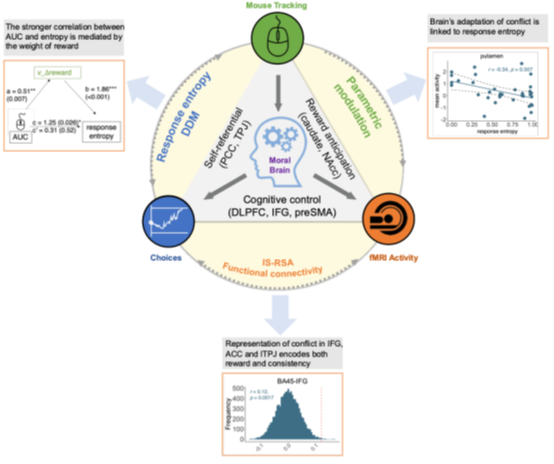
Summary of the study