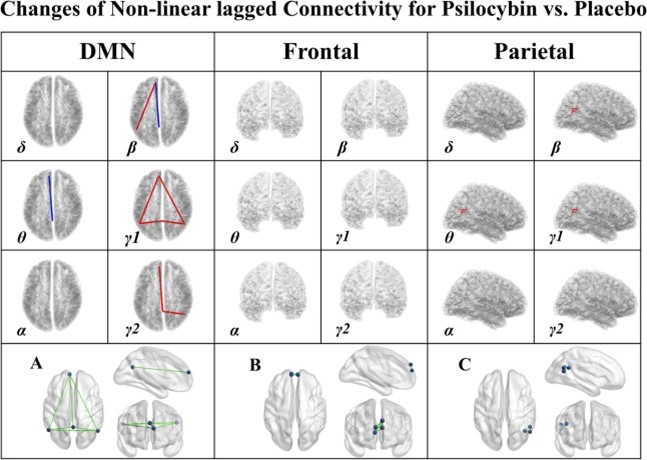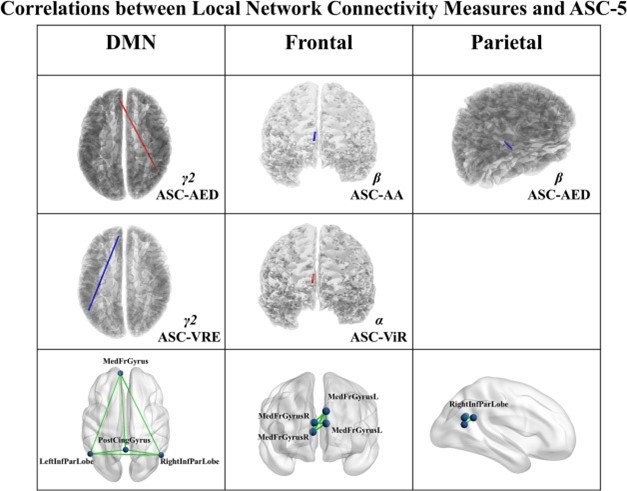


An international collaborative study led by Prof. Cheng‑Teng Ip, assistant professor at the Centre for Cognitive and Brain Sciences, University of Macau (UM), has identified brain rhythms and connectivity induced by psilocybin that correlate with subjective psychedelic experiences. The research results have been accepted by the international journal Progress in Neuro-Psychopharmacology and Biological Psychiatry (5-year IF: 4.8).
Psilocybin has shown its therapeutic potential across mental health disorders. As a potent serotonin 2A receptor (5-HT2A) receptor agonist, psilocybin has shown promise in treating depression, addiction, and post‑traumatic stress disorder. Although Australia recently approved psilocybin for treatment‑resistant depression, its mechanisms remain complex. Molecular studies have reported that psilocybin affects 5‑HT2A receptor activation as well as TrkB receptor binding and brain-derived neurotrophic factor (BDNF) signalling. Despite these insights, the neurobiological factors underlying individual variability in response are still poorly understood, underscoring the need for biomarkers to guide personalized therapeutic strategies.
A total of 25 healthy participants (18 males, 7 females, average age 24 years) took part in a double‑blind, placebo‑controlled, crossover study. Each participant received a weight‑adjusted oral dose of psilocybin (mean dosage 225 μg/kg) and placebo in separate sessions. Resting-state EEG was recorded at baseline and 60 minutes post‑dose (before the expected peak of effects). Source reconstruction and connectivity analyses via sLORETA focused on the default mode network (DMN) and localized frontal and parietal subnetworks. Subjective experiences were assessed by the Altered States of Consciousness (ASC‑5) questionnaire.
The study revealed that psilocybin significantly decreased EEG power in slow frequency bands (theta and alpha) while increasing power in fast frequency bands (beta and gamma) in different regions. Connectivity analyses revealed that psilocybin decreased connectivity in theta and beta bands and increased connectivity in beta, gamma1, and gamma2. In the parietal network, connectivity was significantly enhanced in theta, beta, and gamma1 bands. The psilocybin-peak EEG power sources and connectivity were strongly correlated with the values of the ASC‑5 items. Importantly, this study also found that baseline EEG power values could predict the changes in different ASC‑5 items affected by psilocybin.
This research was supported by the University of Macau (SRG2023‑00040‑ICI & MYRG‑GRG2024‑00022‑ICI) and the Science and Technology Development Fund (FDCT) of Macau (0092/2025/ITP2), the Swiss Neuromatrix Foundation, and the European Union’s Horizon 2020 Framework Program for Research and Innovation under the Specific Grant Agreement No.945539 (Human Brain Project SGA3). The full version of the article can be viewed at: https://doi.org/10.1016/j.pnpbp.2026.111626
Source: Centre for Cognitive and Brain Sciences, University of Macau